


We recommend cardiac rehabilitation (rehab) all patients following a cardiac event. It is a structured programme to support you and your recovery, which includes:
- Information
- Education
- Exercise
- Relaxation
Cardiac rehab classes offer regular sessions of supervised exercise. We will tailor the exercises to the ability of those who attend.
You will learn more about your condition, ways to relax, and how to promote better health and protect yourself for the future.
Cardiac rehab programmes are relaxed, sociable and fun with specialists. We provide information on several health topics and answer questions.
Cardiac rehab will have a positive impact on your well-being and quality of life and is proven to:
- Maintain lifelong healthy heart habits.
- Reduce risks of further cardiac events.
- Improve quality of life.
- Be an important part of long-term recovery.
Who is it for?
- Primary angioplasty
- Myocardial infarction (heart attack)
- Elective angioplasty with stents
- Medical management of coronary artery disease
- Heart failure
- Coronary artery bypass grafting (CABG)
- Valve surgery
- Aortic root repair
- Heart arrhythmias
- Any other cardiac surgery
It is normal to feel anxious regarding exercising after a heart event, however participating in a cardiac rehab programme can help build your confidence to become active again.
It will give you the opportunity to ask questions and discuss your concerns with friendly, non-judgmental, informative staff and meet other people who have had similar experiences.
Cardiac rehab phases
There are four phases of cardiac rehabilitation. The first phase – Phase 1, occurs whilst you are in hospital after your cardiac event.
When you are discharged from hospital, the next 3 phases of cardiac rehab will occur.
Phase 1
A member of the cardiac rehab team initiates phase 1 on the ward prior to your discharge home.
All patients receive:
- Appropriate advice on their recovery.
- Individualised information about risk factors.
- Education about healthy lifestyles.
- Advice on medication.
- Relaxation techniques as well as psychological support offered.
- Where necessary signposting to smoking cessation services.
We will provide you with an introduction to simple exercises in a cardiac rehab booklet for you to take home.
We encourage all patients to attend a cardiac rehab programme within phase 2. With your consent, we will refer you to a local cardiac rehab team.
Phase 2 – Cardiac rehab
Phase 2 of cardiac rehab can last between 1 to 6 weeks depending on your cardiac event and introduces exercises as well as your safe return to functional mobility.
Towards the end of phase 2, you should be ready to begin more independent exercise and activity within phase 3.
Phase 3
This is the formal exercise programme that can begin between one to six weeks after your cardiac event.
All courses last for eight weeks with an opportunity for patients to develop a greater understanding of their condition and how they can reduce the risk of further coronary heart disease. Through a combination of exercise aimed to improve cardiovascular fitness, comprehensive education and information, relaxation and support.
During the cardiac rehab classes, we will encourage you to work at your own pace. You will start slowly and gently and to increase your exercise gradually over the course of the programme.
We will monitor your heart rate and blood pressure and we will introduce you to the BORG scale. This is a way of measuring physical activity intensity level by how hard you feel like your body is working.
BORG score
| Rating | Descriptor | |
|---|---|---|
| 0 | Rest | |
| 1 | Very, very easy | |
| 2 | Easy | |
| 3 | Moderate | |
| 4 | Somewhat hard | |
| 5 | Hard | |
| 6 | ||
| 7 | Very hard | |
| 8 | ||
| 9 | Extremely hard | |
| 10 | Maximum exertion |
As well as participating in the structured exercise programme within the cardiac rehab programme, we also encourage you to increase your level of activity outside of the programme by walking, using your rehab booklet from hospital or accessing the British health foundation online exercise videos.
Therefore, it is important for patients to learn the BORG score to adapt this when they are exercising independently outside of cardiac rehab class.
We will reassess you at the end of phase 3 to show your progress. This information will be sent to your GP.
All patient information is entered (anonymously) on the British Association of Cardiac Rehabilitation’s (BACPR) National Audit for Cardiac Rehabilitation (NACR).
Phase 4
Following your cardiac rehab course, you may wish to maintain the benefits of physical activity and lifestyle modification gained, by attending a further exercise programme – this is known as Phase 4.
The Freeman cardiac rehab team have close links with local Phase 4 programmes and can directly refer you onto a structured community-based class that has qualified BACPR Phase 4 instructors that lead the programme
Our team
We are a small, dedicated team of caring specialised nurses who you will first meet whilst you are in hospital when we facilitate your Phase 1 cardiac rehab.
We work alongside physiotherapists and physiotherapy assistants to provide Phase 3 cardiac rehab classes.
These aim to support and help you on your recovery journey providing:
- Safe structured exercise
- Confidence building
- Understanding your heart condition
- Support long term lifestyle changes and prevent future cardiac events.
We also have input from other members of the multi-disciplinary team. These include a dietitian, pharmacist, psychologist, and resuscitation instructors.
When are the cardiac rehab sessions?
The Phase 3 cardiac rehab programme held at Freeman Hospital has two evening classes twice a week:
- Monday 5:30pm – 7:30pm
- Thursday 5:30pm – 6:30pm
The sessions are held within the physiotherapy and occupational department at Freeman Hospital.
You are welcome to come along and observe a class, talk to staff and current members, if you feel apprehensive, as we know for some it may be the first time they have exercised within a regime.
Please call first to arrange a visit if you feel this would benefit you.
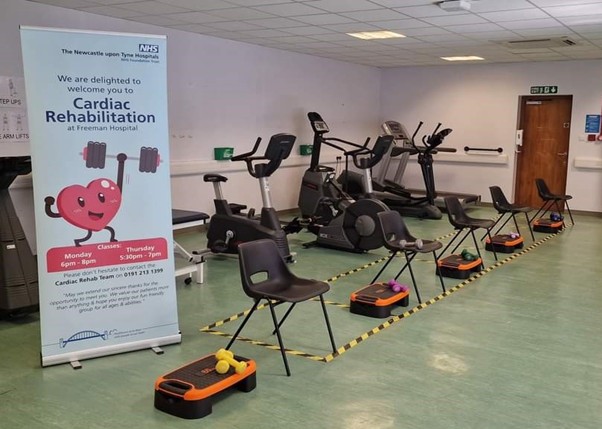
What to expect from the rehab classes
The exercise component of the session is approximately 45 minutes.
Each session starts with a gentle warm up, then individualised active exercises tailored to you and your condition begins. It is essential that you are working at the right exercise level for you to gain the most from the sessions.
Doing exercises can be daunting for some, the rehab team ensure you are supervised throughout, with everything designed to your needs and abilities.
It is important to remember that different people recover at very different speeds depending upon your age, heart condition and treatment received.

After exercising we end with a cool down, and stretches, before everyone joins in a short relaxation session, which is a great aid to reduce stress and can be used effectively at home once practised.
Monday cardiac rehab
A Monday cardiac rehab class has different educational topics discussed by members of the team. This includes nurses, dietitian, a pharmacist, a psychologist as well as resuscitation instructors.
The educational topics include:
- What is coronary heart disease
- Risk factors
- Diet and healthy eating
- Types of fats, food labelling
- Medication
- Exercise
- Managing stress
- How to perform resuscitation
The educational time provides great opportunity to ask questions and increase your understanding of each topic. Learning about these topics provide information and insight, to help make lifestyle changes to improve your quality of life.
We invite and encourage partners/carers/family members to attend and take part in the “How to perform resuscitation” session.
Rehab programmes allow you to meet others that have had similar experiences and gives you the opportunity to support and help each other. However, the Team pride ourselves on the emotional support we provide which enables members to relieve stress, increase confidence and improve mental health.

What else do I need to know about cardiac rehab classes?
- Wear loose, cool comfortable clothing and non-slip supportive sport-type shoes.
- Bring a bottle, with water or dilute juice to keep hydrated whilst exercising.
- Bring your GTN spray, if you use one.
- Do not eat a heavy meal 2 hours before exercising, however a light snack is ok.
- Bring reading glasses and hearing aid if you require them.
Completion of the programme – what’s next?
When you are nearing the end of Phase 3 at Freeman, we discuss your plans to keep up your good work. Something you can maintain and enjoy – return to a hobby or start a new one – golf, swimming, cycling, join a gym it’s your choice.
Remember there is something for everyone, keep it fun, and keep active!
Alternatively we can refer you onto a Phase 4 cardiac rehab which is community-based with qualified BACPR instructors.
Patient experiences
Patients that previously attended Phase 3 cardiac rehab programme kindly gave us some feedback which you can read below.
I would be lost without cardiac rehab. I have learned so much about me and my condition. My outlook is not how long you live, it’s what you put into your life.
The team are truly amazing; nothing is a bother. They are so caring, and want the best for us all. I really appreciate each and every one of them!
Definitely worthwhile, I was scared to exercise after my valve surgery, as well as being deconditioned after being in hospital so long. I attended all the classes, and I’m now back to hill walking and swimming twice a week
I was worried at first, thinking the cardiac rehab class would be Lycra and sweat bands, with stereotypical gym goes. I was completely wrong. The staff and other patients (or should I say – now my friends) were all so friendly and welcoming.
No one is judged on what they can or can’t do. Everything is designed to what you can do. The group has developed my confidence sharing all our experiences and sometimes supporting one another. I was gutted when I completed phase III Rehab at Freeman, but so proud at how far I had come and what I had achieved
Build your exercise up gradually, increasing regularly and exercise every day. If you are offered a rehab group, take up this offer its well worth it – it will change your life for the better
The classes make me feel energised and refreshed, and I can’t wait for the next one!
My own experience, having been operated on at the age of 78 and now approaching 80, is that I have been able to undertake all the exercises recommended without any ill effects at all, and have in fact found them to be highly enjoyable
Cardiac rehab helpline
Freeman cardiac rehab helpline is available to provide specialist knowledge to help and support patients as well as their relatives or carers following a heart event, disease or surgery.
We can provide:
- Opportunity to discuss the implications of your diagnosis.
- Support and advice on how to manage your condition.
- Discuss any concerns you have regarding lifestyle changes, medication.
If there is no-one available to take your call or you call outside these hours, please leave a message and your contact number on our answerphone. A member of our cardiac rehab team will return your call at the earliest opportunity.
Exercising at home
The British Heart foundation have produced some wonderful exercise videos . You can do these in the comfort of your own home.
You should only use them if you have received a cardiac rehab assessment at Phase 2 and/or started or completed a cardiac rehab programme.
Contact
We are here to help any questions, worries or concerns that you or your family, please contact us.
 Service is available Monday to Friday, 8am – 4pm


