


What is knee replacement surgery?
A knee replacement is a surgical procedure carried out to replace damaged areas of the knee joint with metal and plastic material known as a prosthetic implant. This surgery is usually recommended when the knee is severely damaged by arthritis or injury.
Depending on the overall damage, a knee replacement can be used to replace all of your knee joint (total knee replacement) or some of it (partial knee replacement). Your surgeon will determine which type is most suitable for you. They will consider many factors such as your age, area of damage and your general health.
During the procedure, the surgeon makes an incision at the front of your knee around 15 to 20cm. The end of your thigh bone and top of your shin bone are then cut and replaced with the prosthetic implants. Sometimes, the back of your kneecap can also be replaced if this has been damaged as well. The operation usually takes between one to two hours to complete.
Some surgeons may carry out a knee replacement using robotic-assistance technology. This involves the use of a machine which has a robotic arm that helps the surgeon precisely remove the damaged areas of your knee joint. You will be required to have a CT scan prior to your surgery to take images of your knee which guide the surgical team. The surgeon remains in control throughout the entire procedure. It is another tool which can assist surgeons, but they will discuss whether this is an appropriate option for you.
Benefits of knee replacement surgery
The main benefit of this surgery will be to relieve your pain and help your knee joint move better. You will be able to resume most of your daily activities such as walking and driving.
Limitations of knee replacement Surgery
As the artificial joint is not a perfect replacement for your natural knee, you will have to avoid participating in high impact activities such as jumping or running that will place excessive stress on the knee.
Risks and complications
While most knee replacements are carried out without any problems, it is classed as a major operation. All operations carry some risks and potential for complications.
These will have been explained to you during your consultation with your healthcare professional and include the following.
Preparing yourself for your surgery
If you decide to go ahead with your surgery, there are a number of ways you are advised to prepare your body for the best outcome.
Stop smoking and drinking alcohol
It is recommended to stop or reduce your alcohol intake as these can increase your risk of complications. You should stop smoking at least four weeks before your surgery. You should also avoid consuming alcohol at least 48 hours before your operation.
Eat a well-balanced diet
Your body needs adequate nutrients to repair itself after surgery. A higher protein diet and ‘five a day’ or more of fruit and vegetables is recommended before and after your surgery.
Remain active
It is important to carry out daily exercise to keep your body strong and return to normal activities quicker after your surgery. Simple exercises such as walking, cycling or swimming up to 30 minutes a day are strongly recommended. There are also exercises shown later in the leaflet that can be carried out before surgery to maintain your knee strength and movement.
Reduce the use of any opioid drugs
If you are already taking opioids (i.e. codeine, tramadol and morphine), please talk to your healthcare team. You may benefit from reducing these beforehand in a safe manner as it will help pain management after surgery as well as improve your post-surgical outcomes.
Treat any existing health conditions
Contact your GP or relevant healthcare professionals if you have any existing conditions or infections that may impact your recovery. If you have any difficulties with managing your weight, blood pressure; blood sugar levels or anaemia (low level of iron in your body) then these should be managed before the operation as they can increase complications after surgery. Do not
undergo any invasive dental surgical procedures (i.e. tooth extractions) three weeks before surgery and three months after as this can also increase your risk for infection.
Home preparations for your recovery
It is important that your home circumstances are suitable for you upon discharge following your operation. Some people will find it helpful to arrange a family member or friend to stay with them. However, if you live alone, please have your house ready for your arrival back home.
You should consider the following:
- Move any loose rugs or cables that could be a tripping hazard while using walking aids
- Pre-cook and freeze meals if you can, stock up non-perishable and easy to cook items
- Move anything used often from low cupboards to an accessible height to avoid too much bending or stretching
- Arrange the care of loved ones and pets
- Plan for your daily activities
- If you have home care provided by social services, you must inform them of your admission date and date of discharge from the hospital so that these may be restarted.
- If a family member who plans to provide support upon discharge has a planned trip away, please make alternative arrangements if you require support.
Planned appointments prior to your operation
You will need to attend some appointments to help you prepare for your operation which you will receive letters for. These include Pre-Assessment Clinic (PAC) and a patient education class.
Pre-assessment clinic
Pre-assessment clinic is based at the Freeman Hospital (Clinic H) . It is staffed by a large team including nurses and anaesthetists who will complete tests and treatments to ensure you are fit to have surgery.
You can expect following:
- Your full and relevant medical history will be taken
- You will undergo investigations such as heart tracing (ECG), blood tests, MRSA swabs and urine (to check for infections).
- Your medications will be reviewed, and you may be advised to stop taking certain medications prior to your surgery.
- You will be given an antimicrobial wash (Octenisan) to use prior to surgery to reduce the risk of infection. Use this for five days before your surgery.
- You may also be given a carbohydrate powder called preload to drink before surgery which helps with hydration. Take two sachets the day before your operation (6pm and 10pm) and one sachet on the day of your operation (6am).
Pre-operative education class
You should also receive an appointment to attend the pre-operative education class by the orthopedic therapy team. It is held in the physiotherapy department at Freeman hospital. This is usually a group-based session where you will be given guidance on preparing for surgery and your recovery afterwards. You will also be shown exercises and demonstration of equipment.
Days prior to your surgery – things to remember
Fasting time
You need to stop eating solid foods six hours before your operation (no food after midnight). Feel free to drink water (clear fluids only) up until you arrive in the hospital.
Shower/bath
Please use the antimicrobial wash provided (Octenisan wash). This should be for five days before your operation (including in the morning of your operation). Do not use any talcum powders, body lotions, perfumes or makeup after your bath/shower.
Shaving or waxing
Avoid shaving or waxing of your legs, underarms, bikini lines etc. for three weeks prior to your surgery. You must also not have any skin breaks, grazes or open wounds. This is because any area of your body with open skin breaks or wounds may increase your risk for infection into your new joint.
Medications
Follow the instructions from Pre-Assessment Clinic regarding any medications. You must stop any medications exactly as advised by pre-assessment clinic before your operation.
Infections
If you have had diarrhoea, nausea and vomiting 48 hours before your surgery date, or if you have cold or flu-like symptoms please contact us for advice as to whether it is appropriate for you to come in (contact details are provided at the end of this leaflet).
Please be aware If you do not follow the instructions above then your operation may be cancelled, and you will be given a date in the future.
What to bring to the hospital with you?
You should bring
- Your admission appointment letter.
- Day wear for 1 day such as loose-fitting shorts, skirts or shirts that are easy to put on.
- Night wear for 1 night such as a night dress, shorts or pyjamas.
- Flat supportive shoes or slippers that are well fitting and comfortable to walk in.
- Shoes without a back are not recommended.
- New slippers may not fit if your feet become swollen after surgery.
- Toiletries such as face cloth, toothbrush or deodorant.
- Mobility aids that you use such as walking sticks, crutches or wheelchair.
- Medications you regularly take in the labelled boxes with you.
- Books or music player to keep yourself occupied.
Do not bring
- Any controlled pain medication such as Morphine or Oxycodone (tablets or liquid). This is due to safe storage keeping. There are available supplies of these.
- Any valuable items.
- Please do not wear make-up, nail varnish, acrylic or gel nails on the day of your surgery.
Planning your journey to hospital in advance is important. Please allow sufficient time for the journey and potential additional traffic near the hospital to make sure you can arrive in the department at least 15 minutes prior to your appointment time. If you need any assistance, please tell us how we can help you.
Admission to hospital
You will usually come into hospital in the morning of your operation for 7am unless you are advised otherwise.
You will arrive to one of the elective surgical units at the Freeman Hospital. This will be either ward 4, ward 19 or the Day Treatment Centre. Please check your letter to confirm this.
- Ward 4 is located on level 3 in the Freeman Hospital
- Day Treatment Centre is located at the front right of the Freeman Hospital Site (the centre is signposted from the main care park entrance).
- Ward 19 is located on level 7 at the Freeman Hospital. This is the main elective orthopaedic ward, and you are likely to be transferred to this ward after your operation.
Please note the following regarding visiting:
Visiting hours
Ward 19
1pm to 5pm and 6pm to 8pm.
Only 2 visitors will be allowed at a time.
No visitors will be allowed during mealtimes. Mealtimes: 12pm to 1 pm, 5pm to 6pm.
Ward 4 and Day Treatment Centre
Visiting on Ward 4 or the Day Treatment Centre is not permitted unless prior arrangements have been made with the nursing team.
When you arrive, you will be seen by a member of your surgical team, your anaesthetist and a nurse. They will all carry out essential checks prior to your operation and discuss the anaesthetic and surgical plan with you.
Anaesthesia for knee replacement surgery
Most patients have their knee replacement carried out under spinal anaesthesia. This is an injection in your lower back that makes your legs numb for the operation so that you cannot feel pain during surgery.
You will be offered some sedation to help you relax during the operation, but you will not be fully asleep. You can also request to listen to music in theatre, or you may be able to use a VR (Virtual Reality) headset during your operation.
We would recommend this approach unless there is a reason not to. This anaesthetic allows patients to make a rapid recovery with fewer side effects, which allows and promotes early mobilisation.
If you have a general anaesthetic, you will breathe some oxygen from a mask before going to sleep with an injection.
You may also be given a nerve block which is local anaesthetic injected around the nerves near your knee joint to provide you with additional pain relief.
Your anaesthetist will discuss which anaesthetic option is most suitable for you on the day of your surgery. Further information on anaesthetic management may also be discussed during your pre-assessment clinic appointment.
Once all checks and assessments have been completed, you will be escorted to the operating department to undergo the surgery and then transferred to the recovery area for a short period of time where you will be monitored closely. You will then be taken back to the relevant ward/discharge unit where you will remain for the rest of your stay.
Recovery on the ward/discharge unit
When you arrive on the ward, the nursing team will regularly monitor your vital signs such as your blood pressure, pulse and oxygen levels as well as your wound dressings and pain levels.
To ensure a safe and rapid recovery, you should expect the following:
- You are encouraged to eat and drink soon after your operation to ensure your body takes in nutrients.
- You will usually get dressed into your normal clothes as soon as possible.
- You will get out of bed as soon as it is safe to do so by a physiotherapist or nurse
- Routine pain relief and other drugs you may take will be given. If you need extra pain relief medicines, please ask.
- You will be discharged once you have completed all assessments and goals by your medical and therapy teams.
Managing your pain
You should expect to experience some level of pain, however severe pain is not something you have to put up with.
The amount of pain will be different for everyone and is better controlled if you take your pain relief regularly. This will help you recover rapidly and complete your exercises as comfortably as possible.
- You will routinely be prescribed Paracetamol and Morphine Sulfate solution (Oramorph) as this is most effective pain relief following surgery.
- Use ice (such as a bag of frozen peas) to help manage your pain and swelling. You should keep this on for 20 minutes every hour or as often as required.
- Relaxation and distraction can also help such as listening to music, reading books, watching movies and breathing exercises.
Side effects of pain relief medications
Please be aware that some pain relief medication may have side effects.
These may include:
- Nausea and vomiting
- Constipation
- Headache
- Dizziness
- Feeling sleepy
- Sometimes mild confusion.
These side effects can be reduced by anti-sickness drugs, drinking plenty of fluids, taking laxatives and appropriate rest.
Physiotherapy after surgery
You will be seen by a member of the physiotherapy team as early as 3 to 4 hours after your operation. They will show you how to walk correctly using an appropriate aid (usually elbow crutches or a walking frame).
Once you are safe with this, you will then practice completing some steps or stairs if this is necessary for your discharge home. You will also be provided with knee exercises that focus on restoring strength and movement of your joint.
After you leave hospital, you will usually be referred to outpatient physiotherapy within a couple of weeks by a member of the ward physiotherapy team. During this appointment, your exercises and knee function will be reviewed and progressed. The number of outpatient physiotherapy sessions you receive depends on your individual needs.
Guidance for managing steps and stairs
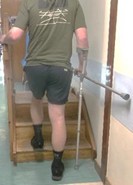
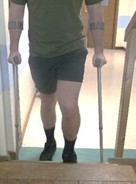
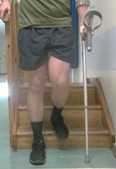
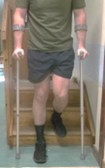
Follow the general guidance below. Always go one step at a time.
For going upstairs
- Stand close to the step.
- Step up with your un-operated leg first followed by your operated leg and then your walking aid(s).
Using 1 crutch and 1 rail
Using 2 crutches
For going downstairs
- Stand close to the step.
- Place your walking aid(s) down first followed by your operated leg and then your un-operated leg.
Using 1 crutch and 1 rail
Using 2 crutches
Knee replacement exercise program
You will be shown an exercise program to complete as part of your recovery. It is crucial that you complete these exercises 3 to 4 times per day and these will usually be progressed over a period of weeks as your knee heals.
You can also start these before your operation to strengthen your muscles and improve your joint movement.
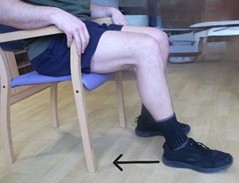
Knee bend in sitting
- Sit up straight on a chair, so that your feet are supported on the floor.
- Slide your foot backwards on the floor and bend your knee as much as possible.
- Hold for 10 to 15 seconds. Return to the starting position.
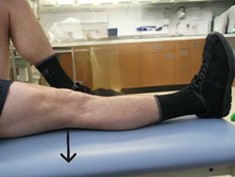
Static quadriceps
- Lie on your back with your knees straight.
- Bend your ankles and press the back of your knees against the bed by using your front thigh muscles.
- Hold the tension for 5 seconds and then relax.
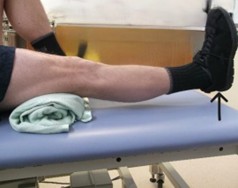
Inner range quadriceps
- Lie on your back with one leg bent and the other leg straight. Place a towel roll under the straight knee.
- Bend your ankle and straighten the knee using your front thigh muscles. Keep the back of your knee against the towel roll.
- Hold the tension for 5 seconds and then relax.
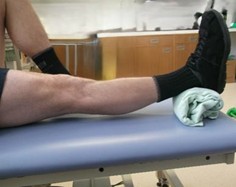
Knee extension stretch
- Place a rolled towel under your ankle and let your knee relax down towards the bed.
- Straighten your knee further by tightening your thigh muscles and pushing towards the bed.
- Hold for the count of 5 seconds.
Discharge from hospital
You will be discharged from the hospital usually within 24 hours after your operation once you are medically fit and safe to do so. It can be the same day or next day after your operation.
You may go for an x-ray, and your bloods may be checked before discharge. This will depend on your consultant and medical team.
You are encouraged to plan your discharge such as transport to your discharge destination and arrange family / friends / carers to support your recovery.
Prior to discharge, your nurse looking after you will check that you have completed all the appropriate assessments and discuss the necessary appointments you will need to attend after discharge.
What follow-up appointments should I expect?
Wound check
You will need a wound check at 2 weeks after surgery. You will need to arrange this with your GP practice nurse.
Follow-up arthroplasty review
You will have a follow-up check in 6 to 8 weeks by your orthopaedic team (usually an arthroplasty nurse specialist). You will receive a letter in the post for this appointment.
General care at home
Wound care
You will have a waterproof dressing over your incision site. Keep the waterproof dressing clean, dry and covered until your wound review. Your clips or stitches needs to be removed between 10 to 14 days after your operation.
When you take a shower, make sure you protect the dressing. The dressing over your wound has a bacterial barrier to help reduce the risk of infection.
If you have any issues with your dressing, then please contact fracture clinic or ward 19 (contact details can be found at the end of this leaflet).
Pain relief medication
You will be discharged home with a short course (five days) of strong pain relief medication (such as morphine). As your pain lessens, you can reduce taking these. Remember to also take other pain medication you will have been prescribed (such as paracetamol and ibuprofen) regularly.
If your pain is not well managed at home or if you are still struggling with high levels of pain, you should contact your GP surgery to get further help.
Surgical stockings
Depending on your consultant, you may be advised to use surgical stockings for six weeks following your surgery to improve blood circulation in your leg. You will receive an extra pair of stockings upon discharge.
Going to the toilet
For the first two weeks after surgery, it is common for bowel movements to become irregular. This can be because of pain relief medication combined with less physical activity and a change of routine. This will resolve itself as you get back into your usual routine at home. Eating high fibre foods such as fruits, vegetables and wholemeal bread can also help manage. If necessary, try taking a mild laxative for a few days until you return to your normal routine.
Blood thinner medications
You will be advised to take blood thinning tablets or injections following your surgery. This is to reduce the risk of developing blood clots in your body.
If you are already on blood thinners, you discharge letter will state when you should start back on these.
Swelling management
Swelling of your leg is very common and may last for several months. Pressure changes and reduced activity may cause your operated leg to swell, especially when it is just healing. By the end of the day lots of people also complain that their ankle is more swollen.
To reduce swelling, take appropriate rest in-between activities and use ice as needed.
General advice around return to activity
Once you get home, you should increase your activity levels gradually. It is not unusual to feel tired, and your sleep patterns may take a while to return to normal.
Walking
Start with walking short distances around the house and garden in the first two weeks then increase as you feel able. You should gradually build up on your walking as pain and fatigue allows.
If you are using crutches, you should wean yourself from these as soon as you feel steadier on your feet so long as it does not cause you to limp. Start by weaning yourself down to one crutch on the opposite side.
Washing and dressing
You should be able to return to showering when you feel confident to do so but we recommend having strip wash initially in the meantime. You should protect the waterproof dressing until staples/sutures are removed or is fully healed.
Do not take a bath until your wound is completely healed in 6 to 8 weeks’ time.
Sleep
Difficulty sleeping is a common complaint after a knee replacement, but you may sleep in any position.
Do not put a pillow or towel under your operated knee for comfort while resting. It can be tempting for comfort but pillows under the knee cause it to bend, making healing more difficult and upsetting the surgical site.
Driving
It is recommended that you do not drive for 6 weeks after your operation, but your healthcare team can advise you on this. When you are ready to start driving, make sure you can reach and use the pedals without discomfort. Have a trial run without the engine on. Try out all controls and go through the emergency stop procedure. Start with short journeys and when you do a long trip, stop regularly to get out and stretch.
Please be aware that if you drive soon after your surgery and have an accident, insurers may consider you liable for damage. It is advised that you check with your insurance company first, before driving.
Flying
You should avoid taking long haul flights for three months after your surgery to reduce the risk of developing blood clots in your body.
When going through security, be aware that the sensitivity of metal detectors varies, and your artificial joint may cause an alarm. Tell the screener about your artificial joint before going through the metal detector.
Sexual activity
Return to sexual activity depends on your condition but you may be able to resume within 4 to 6 weeks after your surgery. You should only resume when you feel ready and be careful not to stress your knee joint while the soft tissues are healing.
Return to work
This depends on the type of activities involved in your job and general recovery. In most cases it’s usually safe to return to light work or an office-based job within six weeks of the operation.
If your job involves heavy duties, you may need to be off work for several more weeks. If your employment has an occupational health department, they can advise you on this or alternatively discuss with your clinical team.
Return to usual exercise and sports
You should avoid high impact activities which put excessive strain on your new knee joint such as running or jogging. Low impact activities such as cycling, swimming and golf are generally recommended. You should avoid public swimming pools for six weeks to reduce risk of infections.
Many people are able to return to these activities within 2 to 3 months. Please speak to your physiotherapist, specialist nurse or consultant if you would like further guidance.
Common complaints
Joint clicks
Many people feel or hear some clicking of the metal and plastic with knee bending or walking. This is normal. These differences often diminish with time, and most patients find them to be tolerable.
Knee stiffness
Although Improvement of knee motion is a key goal, complete full range is uncommon. Most patients can expect to be able to almost fully straighten the knee and to bend it sufficiently to climb stairs and get in and out of a car. The movement of your knee after surgery can be predicted by movement you had before the surgery.
Numb scar
Many people feel some numbness in the skin around their incision. This can be permanent, but your knee function will not be adversely affected.
Kneeling
This can sometimes be uncomfortable, but it is not harmful. You also may feel some stiffness, particularly with excessive knee bending movements. Sometimes placing a cushion under the operated knee can help ease the discomfort.
You should wait at least 6 to 8 weeks before trying to kneel to allow your healing soft tissue time to settle.
Useful contact numbers
If you have any concerns or questions regarding your preparation for surgery or recovery, please contact the appropriate numbers in the following table.
Appointment booking centre (for queries of outpatient appointments)
Tel: 0191 282 4444
Monday to Friday 8:30am to 5pm
Pre-assessment clinic (Freeman Hospital – clinic H)
Tel: 0191 244 8180
Monday to Friday 9am to 5pm
Pre-operative education and surgical prehabilitation team
Tel: 0191 242 4246
Tuesday, Thursday, Friday 8am to 4pm
Fracture clinic (Royal Victoria Infirmary) – Dressings and wound concerns
Tel: 0191 282 1431
Monday to Friday 8.30am to 5pm
Arthroplasty nurse helpline
Tel: 0191 223 1453
Monday to Friday 8am to 4pm
Ward 4 (Freeman Hospital)
Tel: 0191 213 7004
Monday to Friday 7am to 7pm
Helpline out-of-hours – Tel: 0191 213 7019
Day treatment centre (Freeman Hospital)
Tel: 0191 213 7444
Monday to Friday 7am to 8pm
Orthopaedic physiotherapist (Freeman Hospital)
Tel: 0191 244 8219 or Tel: 0191 917 7240
Monday to Friday 8am to 4pm
Orthopaedic occupational therapist (Freeman Hospital)
Tel: 0191 213 7677
Monday to Friday 8am to 4pm
General recovery concerns
If you are worried you are developing a problem or have any concerns about your recovery, please contact the arthroplasty nurse helpline or Freeman hospital ward 19 (out of hours) who will be able to offer support, advice, or organise further reviews if necessary.
Outpatient physiotherapy
If you are registered with a GP practice within Newcastle or Gateshead, you will usually be referred to the Tyneside Integrated Musculoskeletal Services (TIMS) on 0191 445 2643.
If your GP practice is outside of these areas, then you physiotherapist will advise you of which physiotherapy department you will be referred to.
For emergencies
Please contact NHS 111 or A&E
You may also contact the department by phoning the Freeman Hospital on 0191 233 6161 and asking for your consultant’s secretary.
Loan equipment
If you have been given crutches from the ward, please bring these into clinic when you have finished using them.
Any other pieces of equipment should be sent back to your local loan equipment service. If you live in Newcastle, please contact 0191 282 3484. If you live outside of Newcastle, then you can obtain the details of these by speaking to a member of the therapies team.
PALS (Patient Advice and Liaison Service) for help, advice and information about NHS services. You can contact them on free phone 0800 032 02 02, email [email protected]
Useful websites
If you would like further information about health conditions and treatment options, you may wish to have a look at the NHS website at www.nhs.uk
If you would like to find accessibility information for our hospitals, please visit www.accessable.co.uk


