


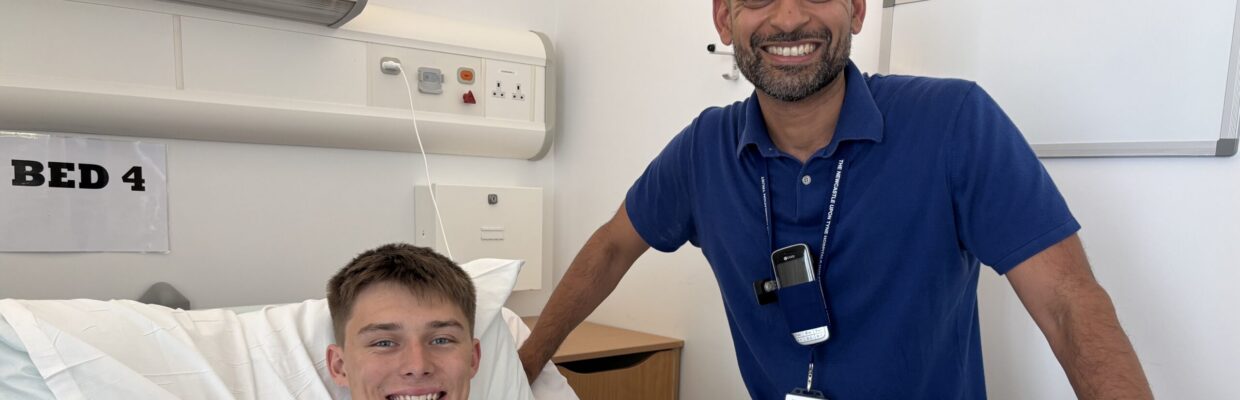
A teenage patient at Newcastle Hospitals has become the first in the UK – and one of the first in the world – to have spinal cord stimulation implant technology fitted to treat his pain in real time.
Ralph Seed of Washington has lived with pain in his foot for five years which was so pronounced the slightest touch could be excruciating for him, leaving him unable to walk or put any pressure on his foot. He suffers with a condition called Complex Regional Pain Syndrome (CRPS).
The 18-year-old has undergone multiple treatments including powerful pain killers, physiotherapy and psychological support, at his lowest point, he contemplated having his foot amputated at the age of just seventeen.
Now he has undergone a surgical procedure to fit an implant device, which uses spinal cord stimulation to disrupt the signals travelling to the brain in real time, to relieve this type of pain.
The device is ‘closed loop’ meaning it reacts to Ralph’s movement, using the body’s own signals to adapt and adjust the stimulation to meet the patient’s needs.
This technique is used to treat severe nerve-related pain such as complex regional pain syndrome. This happens when nerves incorrectly send signals causing severe pain and changes in affected areas of the body.
The technology can be used for this condition when other treatments and medicine have failed.
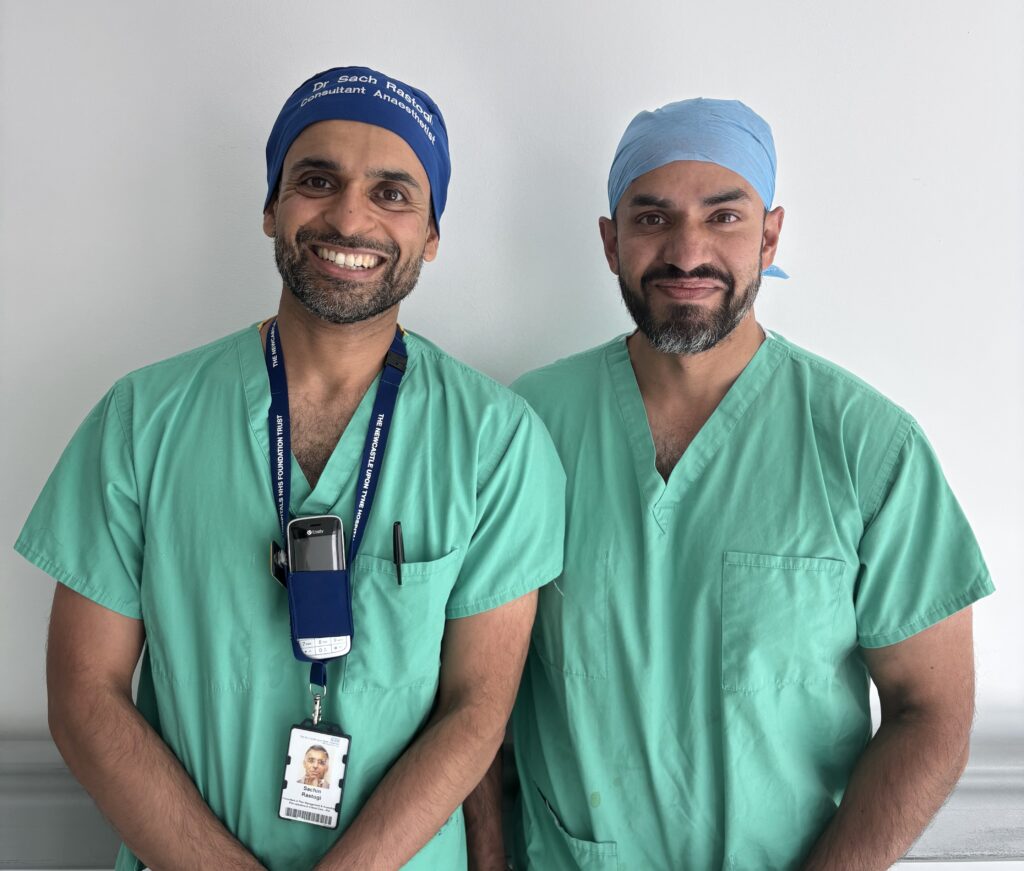
Doctor Sachin Rastogi, consultant anaesthetist who specialises in pain joined Mr Akbar Hussain, a functional neurosurgeon, at Newcastle Hospitals to pioneer the procedure for the first time in this country with a teenager.
The moment the device was switched on after surgery, Ralph’s pain completely vanished.
“The results were immediate and unprecedented for a device like this. Seeing the impact of being pain free for Ralph is simply one of the most moving things I have experienced in my career,” said Dr Rastogi.
“This type of closed loop spinal cord stimulation hasn’t been done in the UK before in an adolescent patient with this type of pain. The response has been so dramatic and that is likely to do with his nervous system being young and highly adaptable.”
He added: “We’ve used a range of interventions to help manage the pain and try to get Ralph’s movement back in his foot, but his pain was still severe and affecting him every day.”
The implant had previously only been used on adults in the UK. As Ralph is the youngest person to undergo the treatment in this country, the team trialled the technology with an exploratory operation to insert the connective leads into Ralph’s lower back to stimulate his spine.
Ralph underwent further follow up surgery weeks later to fit the full implant which was switched on by the team in the ward, and again the pain completely disappeared.
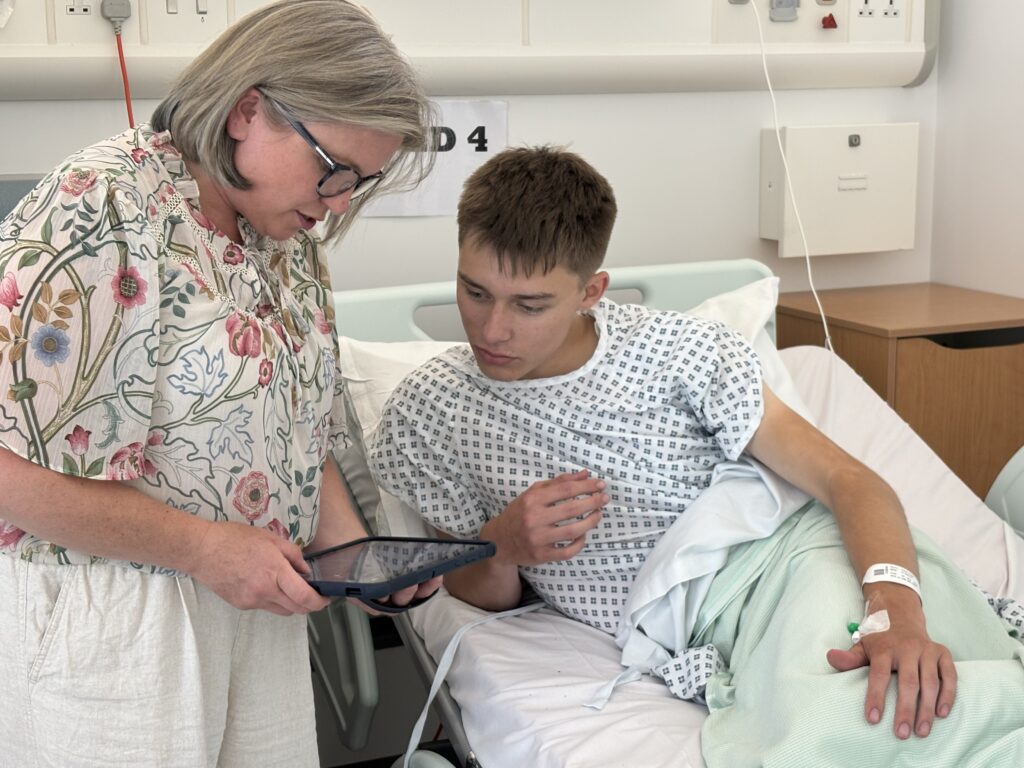
Ralph will continue with rehabilitation with psychology and physiotherapy to work on using and strengthening the full movement in his foot at Newcastle Hospitals specialist Gait laboratory, so the physical improvement including how he walks, his mood and sleep, can be measured along with the pain reduction.
How the technology works
This spinal cord stimulation – using a device called Inceptiv – is a form of neuromodulation, a technique which alters nerve activity by using mild electrical currents to disrupt pain signals before they reach the brain.
- The device – a surgeon places thin wires (leads) near the spinal cord and connects them to a small battery implanted under the skin.
- The signal – the battery sends gentle electrical pulses to the spinal cord.
- The relief – these electrical pulses disrupt or block pain messages, stopping the brain from interpreting them as pain.
The device is the latest neuromodulation technology used by Newcastle Hospitals – other implants are reducing the effects of Parkinson’s, reducing epilepsy seizures and relieving chronic mechanical back pain for these groups of patients.
More information about Ralph Seed of Washington
Ralph first began experiencing discomfort whilst walking, which gradually worsened to the point where he developed a limp.
He visited his GP in Washington and was referred to A&E where they ran tests and referred Ralph to specialist care.
Ralph underwent MRI and ultrasound scans, surgery to examine his hip, steroid and botox injections, blocks of physiotherapy and hydrotherapy but to no avail.
He was then referred to the specialist children and young people’s pain service at the Great North Children’s Hospital, part of Newcastle Hospitals, where he underwent psychological support and pain rehabilitation.
Whilst the service supported him to build the movement in his leg and he learned psychological techniques to help him cope, the pain continued.
By the age of 17 he was experiencing low mood and he began researching amputation of his foot, but was advised by doctors he would have to wait until he was at least 18 to even consider this, and then it was unlikely a doctor would agree to carry it out.
“It impacted my life every day, he said. “It’s been very hard to do the most basic things as I’ve always been in pain.”
When Dr Rastogi suggested trialling the implant for the first time with someone of this age, Ralph and his family weighed up their decision and knew they wanted to go ahead straight away.
“It was a long journey to get here as the pain has affected my life so much,” he said.
“For the first time in five years, I’m pain free. My mum was emotional and so was I. It’s not really hit me, I still can’t get my head around it,” he said.
“I’m hoping the implant is going to help me get my life back again. I kept going, but I couldn’t plan before as I had to think about how I would cope with pain. Now I am planning my future working with cars and going on a road trip with my family,”
Mum Tara Walton, 38, who lives at home in Washington with Ralph, his brother Ernest, 12, and her partner John Walton, 41, added:
“It’s really so special to see him smiling again.
“Ralph has been through so much but throughout he’s had a great attitude, he’s continued to go to school, pushing himself further. He’s been so determined to keep going, showing such resilience passing his GCSEs and going to college.”
Ralph and his family want to raise awareness of complex regional pain syndrome.
“We want other families who may be going through chronic pain to know about this condition and that there is treatment for it. I’m so thankful to everyone for what they have done for me.” said Ralph.


