


Hello, my name is Julie Dixon and I am a Nurse Specialist in Palliative Care.
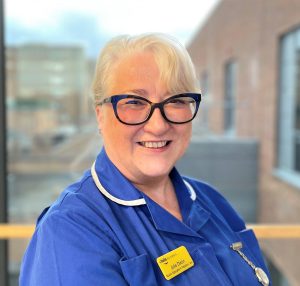
The role of the Nurse Specialist in Palliative care is interesting and diverse. I have previously offered advice and support to teams in the community and hospital who are caring for people who have advanced incurable illness to enable prompt symptom management with the focus on quality of life.
This means we are involved in assessing the complex needs of patients and their families as they approach the end of life and help them focus on their priorities for living and dying well.
The approach we use is an holistic assessment which means we focus not only on physical problems such as pain and nausea but also consider the emotional, social and spiritual needs of the patient.
At the moment I am based in the Freeman Hospital’s Palliative Care Team and work hard to ensure good communication takes place so that planning ahead with the patient and their loved ones to explore what quality of care means to them. This hopefully enables them to die in the place of their choosing with good symptom control and family support.
Focusing on quality of life
The emphasis is on helping patients live as fully and as well as possible even though time may be short. It is important that the patient’s priorities and preferences are explored and a clear plan of care developed with them and the referring team in order to deliver outstanding care at such a sensitive time.
A good knowledge of symptom management is crucial to the role and I am also a nurse prescriber.
Another important part of the role is to share skills and knowledge with other health care professionals so they can deliver the foundations of palliative care in their workplace. This involves teaching informally and in more formal settings with an emphasis on reflective practice.
I encourage staff who refer to the team to reflect on the advice and support they have received and help them to identify how to solve similar problems in the future.
I work closely with other members of ward based teams such as Doctors at all levels of professional development, Occupational Therapists, Physiotherapists, Pharmacists, other Nurse Specialists and Psychologists in order to ensure an holistic approach to care is prioritised.
All of the nurse specialists in the palliative care team are expected to be involved in service development and improvement projects. There is also an expectation that we are flexible in our base of work in order to provide a safe and equitable service across the hospital sites of Freeman Hospital, RVI, NCCC and within the community.
Tell us about your career in palliative care
I started as a student nurse in 1985 and my first job as a staff nurse on a surgical ward in Hartlepool General Hospital sparked my interest in palliative care. Many operations were curative but there was always a number of patients who had palliative procedures and I felt they and their families needed extra support and care at such a difficult time.
I went on to become a senior staff nurse in Leeds General Infirmary in the 1990’s on a ward specialising in upper GI surgery (lots of cancer operations) and had lots of opportunities for further education in communication skills and symptom management.
I returned to the North East in 1994 as a surgical ward sister and later worked as a research nurse exploring drug treatments in pancreatic cancer.
In 1998 I became the first palliative care nurse specialist in the Freeman Hospital and helped develop and grow the service with the help of colleagues at the RVI and NCCT which was based at the old Newcastle General Hospital at that time.
Providing good palliative care is deeply satisfying and although emotional is also uplifting. The true importance of good palliative care is teamwork with the patient and family firmly placed at the centre of all we do.
What makes you passionate about what you do?
I love being a nurse who is able to focus on the priorities of patients and families with a firm emphasis on quality of care and quality of life. It is vital that we continue to involve patients and carers in decision making and advance care planning as much as they would prefer.
We are often involved when patients and families are at their lowest ebb with sadness and anger spilling out. Being able to bring a sense of comfort and calm at those times is deeply satisfying.
Human emotions are often raw with high levels of distress being expressed and of course we cannot pretend that we can make everything perfect in what is an imperfect situation, but I aspire every day to try and reduce the distress and suffering experienced to a more manageable level.
What do you think is the future for palliative care?
I would love to see more time being given to training in our team to upskill our workforce to ensure the delivery of excellent emotional support to people needing input from the palliative care team.
This will also enable us to support ward teams and one another when the going gets tough


