


We have written this booklet is to answer some of your questions and concerns that you may have. The care your baby will be given from several specialists who work in the cleft team. Your baby will be seen regularly by members of this team to plan future treatment, observe your child’s progress and monitor future growth and development.
If you still have any questions, please contact either your specialist nurse or any member of the team.
About clefts
Clefts of the lip and palate are not uncommon and about one in every 700 babies born each year in the UK will have a cleft involving part of the lip and palate (roof of the mouth).
Initially you may feel upset and worry about coping, especially during the first few weeks. We would like to reassure you that help is available for you and your baby.
Our aim is to provide you and your child with the highest standards of care and so obtain the best possible outcomes from treatment. Initially it is not uncommon for parents to feel distress and to be overwhelmed at first. These feelings usually begin to fade as you begin to understand more about cleft lip and palate, meet the specialists involved in the care of your baby and plan for future treatment. However, if these feelings continue, further help and support is available from the professionals within the team.
Please feel free to ask questions at any stage. Any of the specialists will be happy to discuss aspects of your child’s treatment or to arrange for you to talk with one of the other team specialists if this is felt to be more appropriate.
The cleft lip and palate team
- Specialist nurse: Supports parents at home, and gives advice with feeding
- Speech and language therapist: Monitors and treats speech and language problems
- Cleft surgeon: Repairs the clefts
- Geneticist: Investigates the potential reason for the cleft occurring
- Paediatric dentist: Children’s dentist who looks after your child’s baby teeth
- Orthodontist: Dentist who positions teeth with braces
- Ear, nose and throat surgeon: Monitors and treats hearing problems
- Paediatrician: Doctor who treats children
- Clinical psychologist: Offers chance to talk through any difficulties with you or your child
- Anaesthetist: uses medicine to put your child to sleep during the operation
What is a cleft lip and palate?
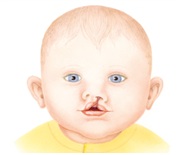
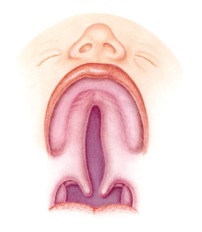
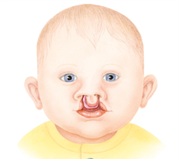
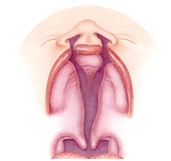
The word cleft means a gap between two parts. A cleft lip and palate is a gap within the upper lip, the gum (alveolus) and the roof of the mouth.
The cleft of the lip may be complete, involving the full length of the lip from the red margin to the nose or it may be incomplete, involving only a part of this area.
The cleft may affect one side of the upper lip, gum and palate (a unilateral cleft), or may affect both sides (a bilateral cleft).
If you wish to see some photographs, your specialist nurse will be able to arrange this.
There are some diagrams showing a cleft lip and palate.
How does a cleft lip and palate occur?
The lips and the palate form during the early stages of pregnancy. Initially they form as separate halves that join. If this joining together does not occur, then a gap (cleft) will be left in the lip and palate. If this happens on one side, then a unilateral cleft develops or if both sides are affected then a bilateral cleft is formed.
Unilateral cleft lip and palate (alveolus involved)
Illustrations by Diane Mercer, Medical Illustrator
Bilateral cleft lip and palate (alveolus involved)
Why do clefts occur?
It is not fully understood why this happens, so as parents it is unlikely that you could have done anything to prevent this. Sometimes there may be a genetic or inherited link with possibly a family history of a cleft lip and palate.
We may ask a doctor who looks at inheritance patterns (the geneticist), to investigate this further.
Occasionally parents may experience feelings of anger or guilt. Such feelings are often part of the necessary coping or adjusting process. Whilst these feelings vary in degree, they are all natural reactions and as such are understandable. In time these early feelings usually pass as you become more confident in looking after your baby and become closely involved in your child’s plan for care and treatment.
How will I feed my baby?
Some babies born with a cleft lip and palate may have difficulty sucking effectively because air leaks into the mouth from the cleft. The wider the cleft in the palate the more difficulty your baby may have in creating the suction needed to withdraw the milk. Babies with cleft lip and palate can appear to be sucking well, but the extra effort needed may lead to tiredness and poor weight gain.
With support and guidance from the specialist nurse, initial feeding difficulties can usually be overcome. Our experience shows that babies with a cleft lip and palate can feed successfully and move on to a weaning diet.
Breast-feeding a baby with a cleft lip and palate may prove more difficult, but it may be possible. However, your baby may need to have extra milk given from a special bottle. This can be your own breast milk or formula milk. If you are bottle feeding your baby, we will provide you with a specialist bottle to overcome the problem caused by the cleft. We will then signpost you to where the bottles can be purchased.
Your specialist nurse will provide some bottles and teats and show you how to use them. Extra feeding bottles can be ordered from the Cleft Lip and Palate Association (CLAPA). Details can be found at the bottom of the booklet.
When you go home from the maternity unit you will continue to get support and advice from your specialist nurse, who will visit you at home.
When will the cleft lip and palate be repaired?
The cleft surgeon is likely to operate on the cleft lip and part of the palate near the gum (hard palate), when the baby is between three to four months old. The rest of the palate (soft palate) is then repaired when the baby is between 10 to 12 months old. However, if your baby was born early or there are other medical conditions then these times may change.
The operations are carried out under a general anaesthetic in hospital. Your baby will be given pain relief both in theatre and on the ward to keep them comfortable.
After the operation the same method of feeding will continue. To keep the lip and mouth clean, you will need to give your baby water after each feed. Dummies or pacifiers are not allowed either during this time.
Recovery is generally quick in babies and feeding is started shortly after the operation. The stay in hospital is usually between one and two nights. If you wish you can stay overnight with your baby, the ward can arrange for one parent to stay. If you have other children, it is understood that this can sometimes be difficult.
Will the cleft lip and palate affect speech?
Many children born with a cleft lip and palate will develop normal speech without the help of a speech and language therapist. Problems can arise when the soft palate is not working properly and does not make a seal between the mouth and nose. Air can then escape into the nose when speaking. This makes speech have a nasal sound.
Some children may have difficulty in making certain speech sounds even though the palate is working well. The speech and language therapist will see your child regularly, so that any problems can be picked up early and therapy offered if necessary.
Will the cleft lip and palate affect hearing?
A cleft of the palate can affect the middle ear and lead to a build-up of sticky secretions – a condition sometimes referred to as glue ear. This condition is quite common in all children; however, it is more common when a cleft palate is present. Glue ear can lead to impaired hearing as such it is recommended hearing is monitored and treated, if necessary.
If glue ear becomes a problem, then an ear nose and throat (ENT) surgeon will make further assessments and advice if treatment is needed.
The most common treatment currently in the UK is an operation to correct this by draining the sticky fluid and placing very small tubes into the eardrums. These are called grommets. Increasingly glue ear is also being treated with hearing aids. Most treatments for glue ear are for a few years until the the glue ear resolves.
Will the cleft affect my child’s teeth?
As the cleft involves the gum area (alveolus) in the top jaw, there may be an extra or missing tooth. Sometimes teeth near the gap may be twisted or may come through later than usual.
The orthodontist will carefully monitor how the teeth come through and bite together. It is important that your child grows up to have healthy teeth. Regular brushing and avoiding sugary foods and drinks will help this.
The first teeth are very important as they help to guide the second or permanent teeth into the best position. If the first teeth are lost early due to decay, then it is more difficult for the orthodontist to straighten the permanent teeth later.
From an early age (as soon as first baby teeth appear) you should begin to take your child along to your dentist who will be able to offer advice on caring for the teeth and gums, as well as providing any necessary treatment.
Our own team will also check your child’s teeth and arrange any help they may need.
After the cleft lip and palate repair will any other operations be needed?
As the cleft also involves the gum then a further operation is often needed at around 8 to 11 years of age to repair the gum to help with adult teeth coming through.
In a small proportion of children, speech and language therapy is not enough to correct continuing speech difficulties and a further operation may be necessary.
The need for any additional surgery will be discussed with you during your visits to the cleft clinic.
Is it possible to meet other parents who also have a child with a cleft?
Yes, your specialist nurse will know other families in your area and can introduce you to them. The parent support group CLAPA (cleft lip and palate association) will also provide local contact with other families. Your specialist nurse can provide you with details of CLAPA and a contact person for your area.
Further information
Contact
Newcastle Cleft Lip and Palate Team
Royal Victoria Infirmary
Queen Victoria Road
Newcastle Upon Tyne
NE1 4LP

Contact
Leeds Cleft Lip and Palate Team
Martin Wing
Leeds General Infirmary
Great George Street
Leeds
LS1 3EX

CLAPA (Cleft Lip and Palate Association)
Useful contacts
PALS (Patient Advice and Liaison Service)
For help, advice and information about NHS services. You can contact them on freephone 0800 032 02 02, email [email protected].
Useful websites
If you would like further information about health conditions and treatment options, you may wish to have a look at the NHS website at www.nhs.uk
If you would like to find accessibility information for our hospitals, please visit the AccessAble website.


