


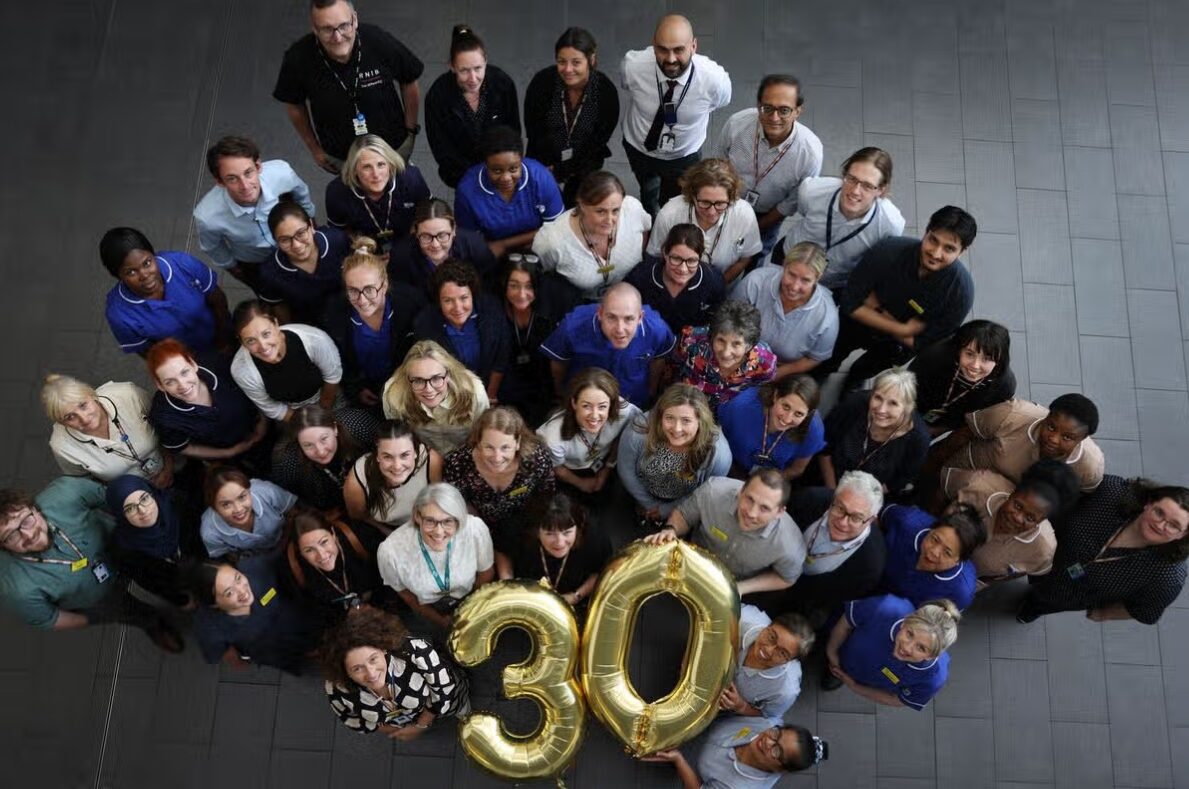
Newcastle’s specialist Claremont wing opened 30 years ago at the Royal Victoria Infirmary, marking a major step forward in the range and quality of eye care services available for city residents and patients in the wider region.
This year’s milestone anniversary marks three decades of providing innovative care, groundbreaking research and life-changing treatments.
Since 1996, the Claremont wing has grown into an internationally recognised centre of excellence, pioneering new treatments and surgical techniques that have improved outcomes for thousands of patients with sight-threatening conditions.
Among those helping to shape its reputation is Professor Francisco Figueiredo, who established Newcastle’s corneal service and developed a new way of working through bringing together highly specialised eye care doctors who manage complex disease and carry out surgery (ophthalmologists) with healthcare professionals who test, diagnose and treat more common eye conditions (optometrists).
This development allowed the Claremont wing to become a hub for providing a wide range of care in one place, including treatments for complex conditions such as keratoconus, a condition where the cornea distorts into a cone shape and severely hampers sight.
Saving sight
A focus on supporting cutting-edge developments allowed Newcastle Hospitals to become the first in the UK to routinely provide a procedure called amniotic membrane transplantation, which uses donated tissue as a biological bandage on the eye, reducing inflammation, relieving pain and promoting healing to prevent scarring.
Over the years, the corneal service has conducted 21 major clinical trials looking at disease and treatment. This has helped bring eight sight-saving products into use worldwide, including Restasis, for the treatment of dry eye disease and Cenegermin, for patients with degenerative nerve impairment which affects the function and health of the cornea.
The service was also the first in the UK to offer telescopic lens implantation for patients with advanced age-related macular degeneration. This innovative procedure uses a miniature telescopic lens implanted inside the eye to magnify images onto healthier areas of the retina, helping patients to regain useful vision and improving their ability to carry out everyday tasks such as reading, recognising faces and maintaining independence.
Alongside these advances, Newcastle’s eye care services are also celebrating over two decades of success as one of only eight national eye retrieval schemes, established by NHS Blood and Transplant to increase the supply and quality of donated corneas for transplantation, helping to restore sight for thousands of people.
Additional innovative developments include:
- International recognition for successfully treating severe eye injuries and rebuilding the eye surface using advanced stem cell therapies.
- Becoming the first NHS trust to adopt a state-of-the-art 3D surgical system for complex retinal surgery, which allows surgeons to gain a clearer, more detailed view, supporting greater precision during complex procedures.
- In complex craniofacial cases, surgeons are using advanced scanning and 3D printing technology to create highly accurate models of the skull, allowing procedures to be planned in greater detail, improving precision and outcomes for patients.
Reflecting on how the service has evolved, consultant anaesthetist, Nancy Redfern said: “Ophthalmology has changed beyond recognition in the last 30 years – the introduction of new technology and techniques has made procedures much faster and more comfortable for patients.
“Working in Claremont gives us access to tailormade space, the latest equipment and a wider team of surgeons and anaesthetists.
“What has never changed is the dedication and kindness of the nurses, doctors, healthcare assistants, porters and everyone else who makes up the eye department team.”
Commenting on the anniversary, Professor Francisco Figueiredo, consultant ophthalmologist, said: “Our specialist teams continue to embrace cutting-edge technology, research and innovation to provide the best possible eye care for patients in Newcastle and the wider region.
“Through providing advanced services, including corneal transplantation, complex surgery and advanced stem cell treatments, we’re able to protect and restore vision, enabling greater independence and improve everyday life for many more people. “Building on the success of the last 30 years, we will continue to ensure patients are able to benefit from world-class eye care and the latest advances in treatment for years to come.”


